intro
In the 1990s, Georgia went to war… with itself.
Newly independent from the Soviet Union, celebrations were in order.
But less than a year later, Georgian blood would spill in the streets at the hand of their fellow citizens.
And it boiled down to pride and perspective… and perhaps Russian meddling.
But how did this country go from being full of hope to hell on earth?
End of Story
If you watched my video or read my essay on Merab Mindiashvili, you already have an idea just how bad the situation was in Georgia at this time.
But that was only the beginning.
Less than a year after his death, a group of Georgians launched a coup on their first post-Soviet democratically elected president, Zviad Gamsakhurdia.
This resulted in him fleeing the country and over a decade of terror for the Georgian people.
You see, Georgia was terribly close to completely failing as a state.
And to this day, the current situation echoes elements of this same period and ones before.
But what would lead a people to do this?
And what would lead others to resist even when it cost them their lives?
historical context
It’s April 9, 1991.
Georgia has just celebrated its vote to separate from the crumbling Soviet Union and made Zviad their president.
As a newly freed nation, excitement was resonant.
But with this came the human element of perspective.
Views.
Ideas about how people should be governed and this caused catastrophic problems.
Yet, these tensions and personal dynamics had already been present.
So, it was only a matter of time before the lid completely boiled over.
It would do you a disservice to not provide context and a clear picture of the players in this story.
So, we’ll go over it right now before going over what actually happened.
the lineup
Zviad Gamsakhurdia
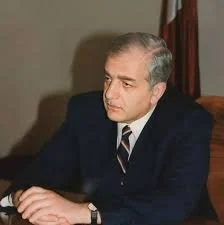
The first democratically elected president of post-Soviet Georgia
Member of the Georgian intelligentsia (the class of people whose work and life largely consisted of intellectual labor)
Anti-Soviet
A nationalist
Mingrelian from western Georgia
Jaba ioseliani
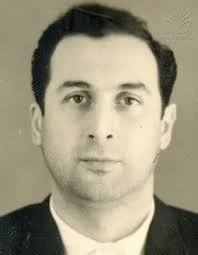
A member of the Georgian intelligentsia
A thief-in-law (a high-ranking criminal in the Soviet and post-Soviet underworld)
A writer
The founder of the armed paramilitary group, Mkhedrioni, meaning horsemen in English
Was arrested by Zviad for "organizing an armed band with the aim of attacking state or public institutions or enterprises" (basically for creating and arming his own militia outside of government control)
One of the three members of the Military Council (the interim government that took over after they ousted Zviad)
Member of the Georgian parliament from 1992-1995
Led a crackdown on Zviadists in western Georgia in 1993
One of the coup leaders that ousted Zviad
An enemy of Zviad
Tengiz Sigua
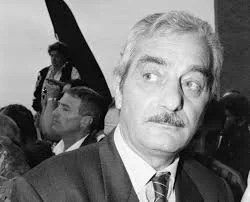
The prime minister of Georgia from 1992-1993
One of the three members of the Military Council
Was originally a close ally of Zviad
Resigned in August 1991 with three other ministers in the Georgian government after disagreements with him
Accused Zviad of being a “totalitarian demagogue"
Became an enemy of Zviad and his government
Tengiz Kitovani
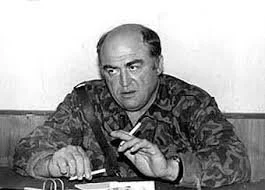
One of the three members of Military Council
Former Georgian defense minister
Co-led coup against Zviad with Ioseliani and Sigua
One of the leaders of the invasion of Abkhazia
Known for his aggressive military tactics
Was initially appointed leader of the Georgian National Guard by Zviad
Committed mutiny by defying reorganization orders given by Zviad and taking between 2,000- 15,000 National Guardsmen + armed supporters with him in opposition (many being in military leadership positions)
Became an enemy of Zviad and his government
Eduard Shevardnadze
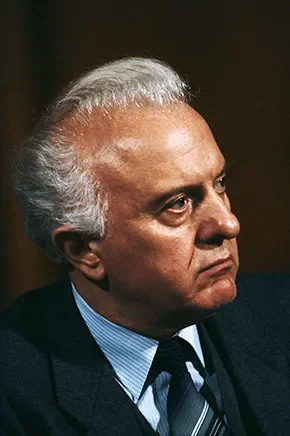
Soviet and Georgian politician
Was the Soviet Minister of Foreign Affairs from 1985-1991
A close ally of Mikhail Gorbachev (the last leader of the Soviet Union)
Was brought back to Georgia in March 1992 as chairman of the State Council
Was elected chairman of the Georgian parliament in October 1992
Survived assassination attempt in August 1995 in which Ioseliani was involved
Was elected president of Georgia in November 1995
Giorgi (Gia) Karkarashvili
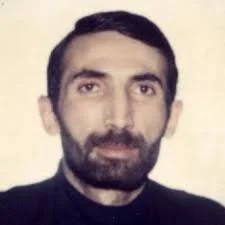
Georgian military commander and politician
Former member of the Georgian National Guard
Became a major general and was made commander of Georgian forces during the Abkhazian War
Dzhokhar Dudaev
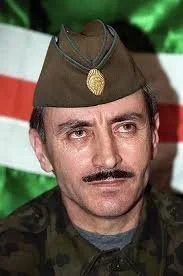
The first president of the self-declared Chechen Republic of Ichkeria
Was an ally of Zviad
Gave him asylum after he fled Georgia due to the coup
Zviadists
Supporters of Zviad
Mainly were from western Georgia (the same place as him) and were rural
Included nationalistic intellectuals and independence activists from the Soviet era
Felt that old Soviet elites still dominated the capital, Tbilisi
Many believed Zviad truly represented independence and complete freedom from Soviet influence
Believed many opponents were Soviet bureaucrats who wanted to retain power
Believed Russia would try to undermine Georgia
Believed Zviad’s election was democratic
Favored strong presidential rule and an ethnonational nation (a form of nationalism that believes shared ancestry and ethnicity is the basis of a nation)
Anti-Zviadists
Opposed Zviad believing he became authoritarian
Were led by Ioseliani and his Mkhedrioni, Kitovani and his National Guard, and Sigua
Had armed militias
Partly composed of individuals who were once allies of Zviad, urban elites in Tbilisi, former Soviet administrative officials, and some liberal intellectuals
Accused Zviad of suppressing the media, persecuting opponents, and centralizing power
Tsitsino (Tsitso) Kevkhishvili
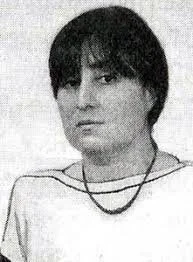
First casualty of the Tbilisi Civil War
Now that we know the people involved in this story, let’s go over what actually happened during those tense two weeks.
Story
It’s the early morning of December 22, 1991.
In the silence of downtown Tbilisi, before the neighborhood has fully awoken, tanks move in on the Parliament building.
No one knows that all hell is about to break loose- except the ones determined to bring it.
They get into position and wait.
Then comes the command.
Giorgi Karkarashvili releases rockets at the building and bullets go flying.
The Tbilisi Civil War is on.
But how did we get here?
Let’s jump back a few years to 1989 and it’ll make a lot more sense.
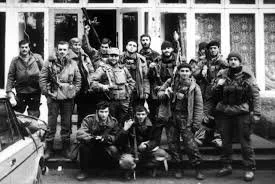
Mkhedrioni members
1989 is the year Jaba Ioseliani created his paramilitary group Mkhedrioni.
Ioseliani was connected to multiple groups in society, remember?
As a writer he had the intelligentsia connect.
As a thief-in-law he was connected to the well-funded underworld.
Additionally, there was tension and hostility growing between Georgians and the minority ethnic groups and regions of South Ossetia and Abkhazia requiring intervention.
Furthermore, there was growing resentment and resistance to the USSR in Georgia.
Due to all of these factors aligning, Ioseliani was able to capitalize on the moment and establish his armed group as a, seemingly, socially legitimate group allowing them to rise to power quickly.
The Mkhedrioni were valuable to some and a threat to others as they could offer enforcement strength, armed protection and thus political power.
Zviad, although he was also anti-Soviet like them, did not agree with their tactics and composition.
So, in February 1991, he had Ioseliani and about 30 other members of the Mkhedrioni arrested for illegally arming a group of people as a militia.
That’s enemy number 1.
The next month, Gamsakhurdia is elected president and Georgia votes itself into independence.
The Georgian National Guard had been formed a few months before on December 20, 1990 and Tengiz Kitovani was appointed commander of them by Zviad himself.
Things seemed fine.
But that simply wasn’t the case.
Numerous disagreements and tit-for-tats occurred throughout the first few months of independence over how Georgia should be run.
But just four months after the elections, the tensions hit an accelerated state in which words became fewer and actions more frequent.
On August 18, Sigua and three other ministers in parliament resigned from their posts in opposition to Zviad’s leadership.
They denounced him as a “totalitarian demagogue” and joined his growing list of enemies.
The very next day, the Soviets attempted their own coup of then leader of the USSR, Mikhail Gorbachev, at his vacation home in Crimea.
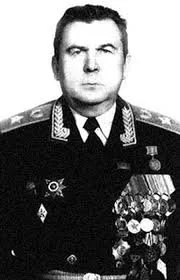
Vladimir Mikhailovich Shuralyov
During this coup, the USSR’s Deputy Minister of Defense, Vladimir Mikhailovich Shuralyov, reportedly demanded that Zviad abolish the National Guard or face an attack by the Soviets.
It’s important to note that the Soviets still had active military bases in Georgia at the time although the country had declared its independence.
The situation was not clean, boundaries were not clear, and a threat of conflict with the Soviets was a very real possibility- especially considering that Georgia was in an unstable state on multiple fronts already.
Right after this, Zviad issued a directive to reorganize the National Guard.
This directive brought the National Guard under the authority of the Ministry of Internal Affairs (Zviad’s power) and eliminated Kitovani’s position as its commander.
And Kitovani was not okay with that.
So, in defiance, he took approximately 2,000-15,000 troops and moved them north from Tbilisi to Rkoni Gorge, dividing the country’s official armed force into opposing factions.
*numbers were often inflated during this time
*some sources says 2-3,000, others say 15,000
*this may depend on if only Guardsmen were counted in the report or if additional armed supporters of the opposition were included
As the National Guard was under the command of their immediate leaders, their loyalty went to them and not the president.
Zviad now had another powerful enemy on his hands.
However, he refused to admit defeat.
The country was officially divided and the opposition had fighters, the criminal world, weapons, and personal issues with their president.
The Mkhedrioni didn’t go anywhere, either.
They teamed up with Kitovani, his guardsmen and Sigua and hatched a plot to overthrow Zviad.
On December 20, 1991, exactly one year after the formation of the National Guard and Kitovani’s appointment by Zviad to the position of commander, Kitovani and the opposition demanded he resign.
But again, he refused.
Two days later downtown Tbilisi was a war zone.
When the fighting broke out, members of the Mkhedrioni overpowered the guards at the prison holding their leader, Ioseliani, broke him out, and brought him to join the coup.
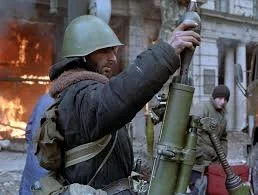
Armed individual during coup
Sigua had set up the opposition’s command post inside Hotel Tbilisi just 250 meters from the Parliament building.
They took up sniper positions and were armed with rockets, RPGs, machine guns and tanks.
Civilians who couldn't escape were holed up in homes and basements during the entirety of the fight.
Zviad and his people retreated to the bunker inside the building for over two weeks as their defense dwindled by the hour.
Still, he wouldn’t give in to their demands.
His family was eventually brought to the bunker to join him after being held at their residence when the fight broke out.
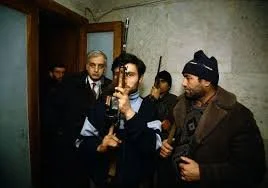
Zviad with loyalists in parliament bunker
Georgia was now officially at war.
Civil war.
Instead of the normal holiday celebrations, the sky was lit up with smoke and the debris of destruction reigned all around.
With the lack of resources to continue the resistance, Zviad, his family, and members of his government fled to Azerbaijan through an exit intentionally left open by the opposition in two armored cars and three buses.
The elected government, not even a year old, was now in exile.
The Legacy
With this defeat, the opposition set up their interim government, the Military Council, composed of the big three: Jaba Ioseliani with his Mkhedrioni, Tengiz Kitovani with his National Guard, and Tengiz Sigua… with himself.
This wasn’t a bloodless coup though.
Between 100-200 people died during this war and hundreds others were wounded.
The first casualty was Tsitsino (Tsitso) Kevkhishvili- a civilian.
Zviadist insurgencies began cropping up largely in western Georgia and the interim government fought to quell them.
And although the oppositional leaders and Zviadists were both anti-Soviet, the opposition ended up bringing Eduard Shevardnadze, a former Soviet politician, back to Georgia to lead the country.
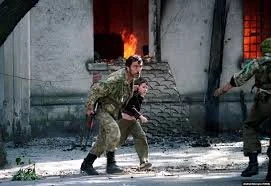
Abkhazian war
Soon after, the Georgian-Abkhazian War popped off leading to yet another horror show; the effects of which are still visible to this day.
Zviad initially was denied asylum in Azerbaijan, received a short-term approval to stay in Armenia, and ultimately was granted asylum in Chechnya.
He died under debated circumstances the following year on December 31, 1993 in western Georgia.
He never ceded defeat.
Additionally, the former Hotel Tbilisi is now the Tbilisi Marriott Hotel on Rustaveli Ave.
The governmental affairs that followed for the remainder of the decade did not go well and would mark this period as a dark and traumatic time in the country’s history.
This war was the result of different perspectives.
Zviad argued that he was reorganizing the National Guard to protect it from Soviet forces attacking it on grounds of it being an illegal militia.
Additionally, he believed that allowing armed militias to exist that did not answer to the government was a recipe for disaster.
Especially for a newly independent nation trying to get its footing.
The opposition argued that him was doing it for personal power and as capitulation to Moscow.
For this and their own personal reasons, they deemed Zviad unfit to lead and accused him of moving toward authoritarianism as the moves he made would strengthen the central government and weaken the power they had at that time
Years later, modern historians argued that Gamsakhurdia used those opportunities to neutralize powerful rivals.
the present day
Today, Georgia is definitely calmer than it was 30 years ago.
However, there is another crisis that has cropped up amongst them.
The current party in power, Georgian Dream, is being met with opposition.
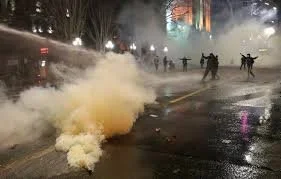
Dispersing of protesters in Tbilisi
They suspended EU talks until 2028, are claiming that some protestors are being funded by foreign actors, and defending the legality and integrity of the 2024 elections that put them in power.
The opposition, however, is demanding new elections claiming that the 2024 ones were stolen, that the Georgian Dream party is imposing restrictive, Russian-style law on the country and physically harming its people.
Conclusion
Although elements of the current situation are echoing the past, many hope that it doesn’t end up mirroring it.
Georgia has strong and resolute people.
Again and again they’ve shown that there are qualities within them that preserve their identity through every trial.
Steel is forged by fire.
But fire still burns.
And it can still destroy and leave painful reminders that never fade.
One of these reminders is from an event that occurred right after the Tbilisi Civil War in 1992.
It was then that almost an entire family was massacred by none other than people associated with the Mkhedrioni (that’ll be the next story).